

With high-profile return-to-office (RTO) mandates dominating headlines over the past few years, it’s easy to assume remote work is virtually dead. Statistics, however, show that’s not the case. In 2025, 12.9% of American workers worked mostly from home, down slightly from 13.3% in 2024 and 13.8% in 2023, and still more than double the pre-pandemic level of 5.7% in 2019.
On Oct. 29, 2026, the U.S. Census Bureau released its 2025 American Community Survey (ACS) results. ACS includes data on the total number of workers in each state and metro area, as well as the number who work mostly from home. Founder Reports, a business and entrepreneurial publication, compiled the data and calculated work-from-home percentages for each state and metro area.
In addition to ranking states and metros based on the latest 2025 survey data, Founder Reports also analyzed annual data dating back to 2019, identified each state and metro area’s work-from-home peak, and compared the 2025 figures with those peaks. The work-from-home trends report reveals interesting patterns showing where remote work is thriving and where RTO mandates have had the biggest impact.
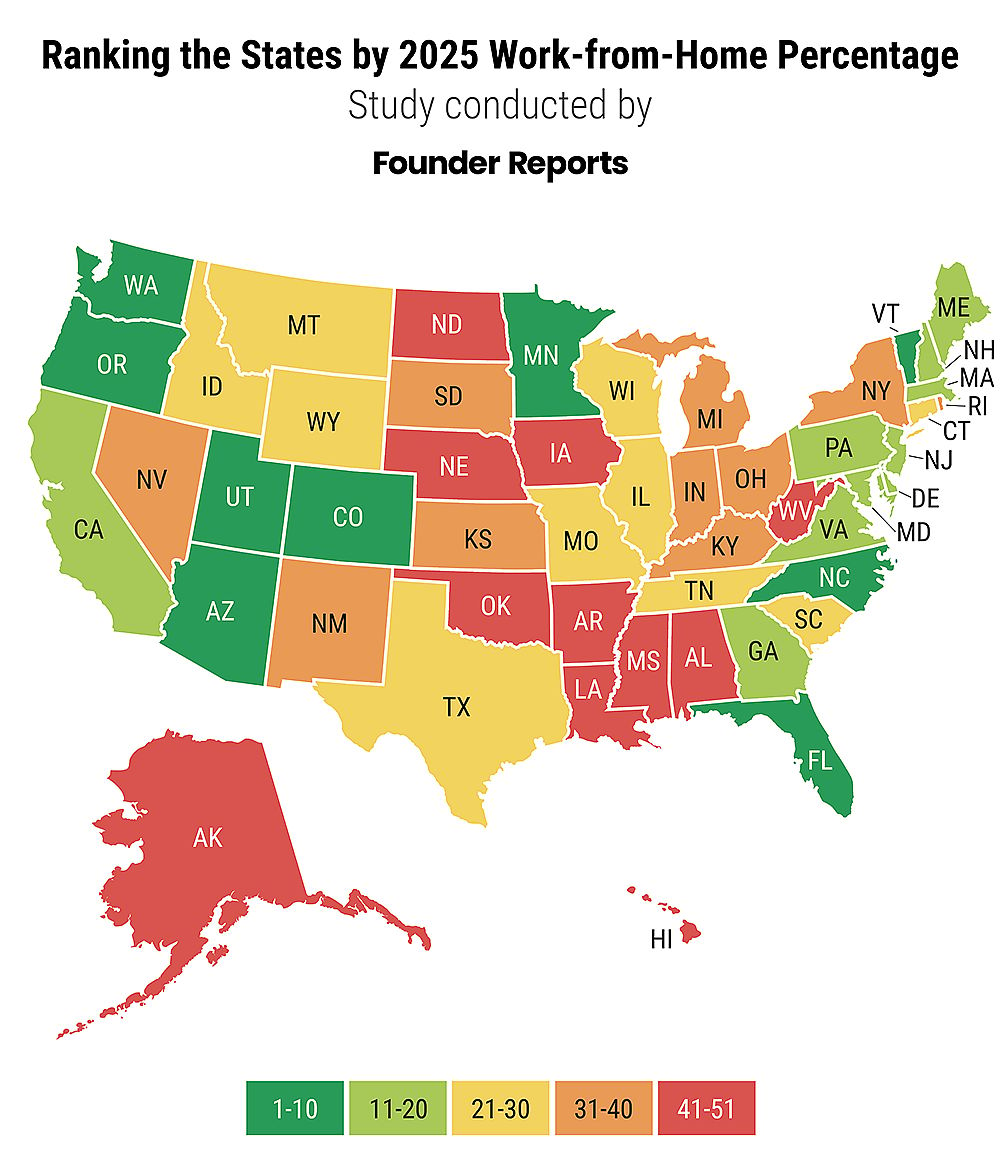
States and metro areas with heavy populations of federal government employees and tech workers experienced the steepest declines in work-from-home percentages. Washington, D.C.’s decline from 48.3% in 2021 to 22.7% in 2025 was sharper than that of any state. Maryland (-10.3 points), Massachusetts (-9.5 points), New Jersey (-9.2 points), and Washington state (-8.5 points) round out the top statewide declines.
The San Francisco Bay Area has also been heavily impacted by RTO mandates, with San Jose-Sunnyvale-Santa Clara (-22.2 points) and San Francisco-Oakland-Fremont (-17.2 points) having the steepest declines of all metro areas. Santa Cruz-Watsonville, California, is the ninth-largest decline, at -10.7 points.
Despite the declines in some areas, remote work remains extremely popular. In a 2025 Founder Reports survey, only 1.8% of current remote and hybrid workers said they would prefer fully in-office work. That preference for flexibility helps explain why the share of remote workers stays strong overall.
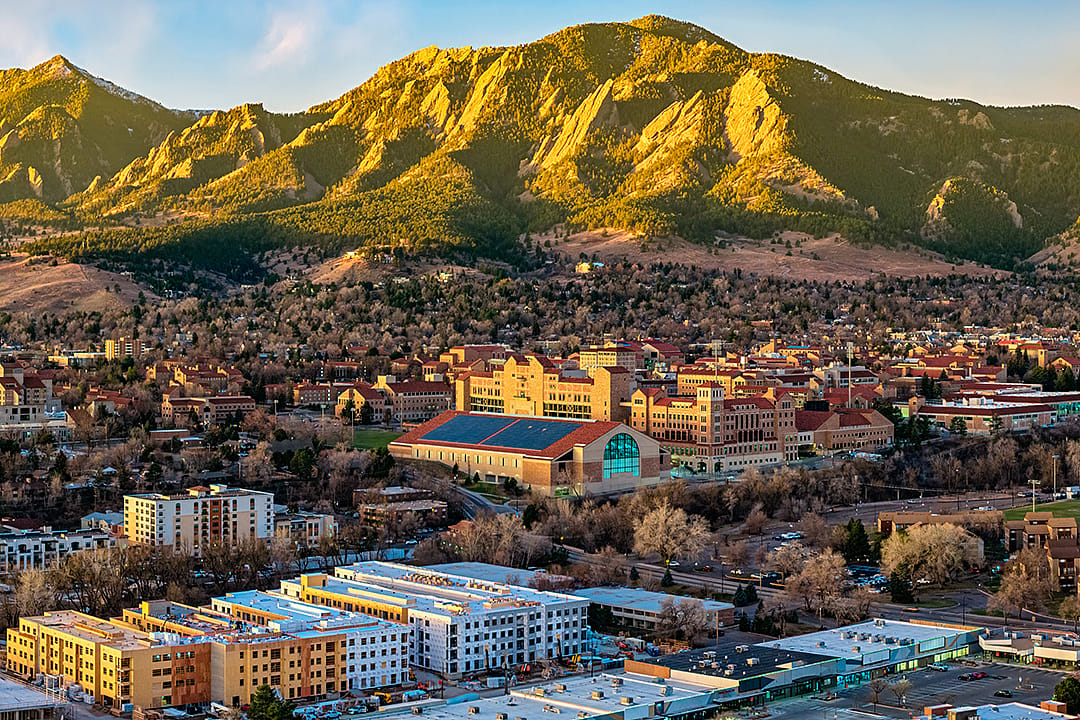
Three Colorado metro areas rank in the top 10 for 2025 work-from-home share: Boulder (first at 24.9%), Denver-Aurora-Centennial (fifth at 21.1%), and Fort Collins-Loveland (tenth at 18.1%). Florida, which ranks sixth among states, has five metro areas in the top 20 nationally.
Two states, Mississippi and Wyoming, reached their peak in work-from-home in 2025. Twelve metros did the same: North Port-Bradenton-Sarasota (Florida), Deltona-Daytona Beach-Ormond Beach (Florida), Logan (Utah-Idaho), Salem (Oregon), Macon-Bibb County (Georgia), Killeen-Temple (Texas), Augusta-Richmond County (Georgia-South Carolina), El Paso (Texas), Hickory-Lenoir-Morganton (North Carolina), Gulfport-Biloxi (Mississippi), Merced (California), and Elkhart-Goshen (Indiana).
1. District of Columbia
Washington, D.C. has experienced a steeper decline from its peak than any state, but still ranks at the top for 2025. With a high percentage of federal employees, Washington, D.C.’s numbers are heavily influenced by government policies.
2. Colorado
This Mountain West remote-work magnet includes three metro areas that rank in the top 10.
3. Arizona
Arizona’s warm climate appeals to many remote workers who have the freedom to live anywhere.
4. Vermont
Vermont is the smallest state in the top 10 (excluding Washington, D.C.). Burlington-South Burlington ranks 19th among metro areas at 17.3%.
5. Washington
Washington still ranks in the top five, despite a significant decline impacted by Amazon and other RTO mandates.
6. Florida
Of 2025’s top 10 states, Florida has experienced the smallest decline from its peak, with five metro areas (Tampa-St. Petersburg-Clearwater, North Port-Bradenton-Sarasota, Orlando-Kissimmee-Sanford, Deltona-Daytona Beach-Ormond Beach, and Jacksonville) ranking in the top 20.
7. North Carolina
North Carolina earns a spot in the top 10, thanks in part to the Research Triangle area, with the Raleigh-Cary metro area ranking second among metro areas at 22.8%.
8. Oregon
Like its neighbor Washington, Oregon still ranks in the top 10 despite a steep decline from its peak.
9. Utah
The Logan and Salt Lake City-Murray metro areas both rank in the top 30 nationally.
10. Minnesota
This cold-weather tech hub rounds out the top 10.
11. Georgia
Atlanta-Sandy Springs-Roswell ranks 14th among metro areas at 17.6%. Atlanta is known as one of the more affordable major cities in the U.S.
12. New Hampshire
The Manchester-Nashua area experienced the 12th-largest decline from its peak, but more than 14% of New Hampshire workers were still working remotely in 2025.
13. Massachusetts
Massachusetts has experienced the third-largest decline of any state (including Washington, D.C.), with the Boston-Cambridge-Newton metro area 11.1 points below its peak.
14. Delaware
Delaware is tied with Vermont for the fifth-largest gain since 2019 (8.8 points).
15. Virginia
Northern Virginia is closely connected to Washington, D.C., with Arlington and Alexandria included in the metro area.
16. Maine
More than 15% of workers in the Portland-South Portland metro area worked remotely in 2025.
17. Maryland
Like Virginia, Maryland’s numbers are also influenced by government employees who work in Washington, D.C.
18. Pennsylvania
Both the Philadelphia and Pittsburgh metro areas had work-from-home rates of about 15% in 2025.
19. California
The Bay Area’s largest metros have seen sharp declines in remote work since the 2021 peak.
20. New Jersey
Outside the New York City and Philadelphia metro areas, the Trenton-Princeton metro has seen a 13.8-point decline from its peak.
21. Texas
Austin-Round Rock-San Marcos ranks third among metro areas at 22.1%, and Dallas-Fort Worth-Arlington ranks 34th at 15.3%.
22. Illinois
The Chicago-Naperville-Elgin metro had a 14.3% work-from-home share in 2025, but rural areas bring the statewide numbers down.
23. Idaho
Idaho is one of only four states to peak after 2021, with Boise (15.5%) ranking as the 33rd metro area in 2025.
24. Tennessee
Nashville-Davidson-Murfreesboro-Franklin ranks 23rd among metro areas, at 17.0%.
25. Connecticut
This state, which has strong commuter ties to New York City, has declined significantly from its 2021 peak.
26. Montana
Montana’s work-from-home share has decreased by about two points from its peak.
27. South Carolina
South Carolina’s work-from-home percentage peaked in 2024. The Charleston-North Charleston (15.6%) metro ranked 31st among metro areas in 2025.
28. Wisconsin
Wisconsin’s manufacturing-heavy economy may limit its potential for remote work.
29. Wyoming
Wyoming, which has no state income tax, is one of only two states still growing in work-from-home work share in 2025.
30. Missouri
The Kansas City (46th) and St. Louis (67th) metro areas both rank outside of the top 40 nationally.
31. New York
New York has experienced the seventh-largest decline among states (including Washington, D.C.), with the New York-Newark-Jersey City metro down 10.4 points from its peak.
32. Rhode Island
The Providence-Warwick metro area ranks 99th nationally at 10.6%.
33. Ohio
At 14.1% in 2025, the Columbus metro has dropped 8.9 points from its peak.
34. Michigan
Ann Arbor ranks 12th among metro areas, at 17.7%, but Detroit-Warren-Dearborn ranks 86th at just 11.5%.
35. Kansas
Wichita has one of the lowest remote work percentages in the U.S., at 6.7%.
36. Nevada
Las Vegas’s service-based economy may limit its remote-work potential.
37. New Mexico
Albuquerque (11.0%) ranks 93rd among metro areas.
38. South Dakota
South Dakota has experienced only a modest decline from its 2021 peak.
39. Indiana
Indiana’s manufacturing-based economy may limit the percentage of remote jobs throughout the state.
40. Kentucky
Louisville (12.0%) ranks 77th among metros, while Lexington-Fayette (10.0%) ranks 113th.
41. Iowa
The Des Moines-West Des Moines and Iowa City metros have both declined from their peak by more than 8 points.
42. Nebraska
The Omaha metro (10.4%) ranks 106th nationally.
43. Arkansas
Arkansas has one of the smallest declines from its peak, although the baseline is low.
44. Oklahoma
Oklahoma’s energy sector jobs are generally less suited to remote work.
45. Alabama
Alabama’s decline from its peak is among the smallest in the country, with the Birmingham and Huntsville metros both above 11% in 2025.
46. Hawaii
Hawaii’s tourism-based economy limits work-from-home opportunities.
47. West Virginia
West Virginia’s rural, service-based economy keeps its remote-work ceiling low.
48. Louisiana
Only 8.7% of employees in the New Orleans-Metairie metro worked from home in 2025.
49. Alaska
Anchorage (8.1%) ranks 138th among metro areas.
50. Mississippi
Although Mississippi is near the bottom of the rankings, it’s one of only two states to peak in 2025.
51. North Dakota
Grand Forks is near the bottom of the metro rankings with a work-from-home share of just 5.8%.
The highest work-from-home metros in 2025
The lowest work-from-home metros in 2025
The ranking includes only metros with comparable data back to 2019. Terre Haute, Indiana (4.7% in 2025), Wichita Falls, Texas (5%), Corpus Christi, Texas (5.1%), Yakima, Washington (5.4%), and Evansville, Indiana (5.5%) all had low work-from-home shares in 2025, but did not have historical data going back to 2019.
The biggest declines from peak
The U.S. Census Bureau’s American Community Survey is the source of all data for this report. Table B08301 (means of transportation to work) was used to identify the share of workers who worked from home in each state and metro area. Founder Reports pulled data for every year from 2019 to 2025, excluding 2020, which the Census Bureau released only experimental estimates due to the COVID-19 pandemic.
The work-from-home share was also calculated using variable B08301_001E (total workers aged 16 and over). Metro areas were excluded from the rankings if they 1) did not have a 2019 ACS 1-year estimate to serve as a pre-pandemic baseline, or 2) had boundaries that were changed in 2023 as part of the federal metro area reclassification (judged by whether the metro’s total worker count moved by more than 4% per year).
This story was produced by Founder Reports and reviewed and distributed by Stacker.


